26 November 2011

Useless Yet Aesthetically Pleasing: Arms & Armor

Sadly I've neglected Artilleries these past few weeks, so I'll attempt to redeem my absence in the coming month.

One of my favorite things to rummage through online museum collections for has got to be metalwork, especially arms and armor. The intricacy in the design of medieval and Renaissance armor is simply fascinating.

Of course, most of the armor found in museums today is flamboyant for a reason. Glitz and glam were not very necessary on an actual battlefield, so most of the armor used in combat was not quite so elaborate as it was practical, and most did not survive to present day. Further, following the explosion (forgive the pun) of firearms use following the Hundred Years' War in the mid 15th century continuing through until the early 1600's, metal armor slowly became obsolete. It failed to protect against modern weapons, and was unreasonably cumbersome (most suits of armor weighed 30kg or more). Thus, armor became a type of formal or ceremonial dress wear and was eventually considered bygone in practical use (don't tell the Swiss Guard).

Armor of Henry II of France, ca. 1555.
Shield of Henry II of France, ca. 1555.
Shaffron of Henry II of France when Dauphin,
Romain des Ursins, ca. 1490-1500.
Gorget, French, ca. 1600-1625.
Burgonet, Italian, Filippo Negroli, 1543.
Reinforcing Buffe with Tilting Targe,
 German, 1560.
Shaffron and Crinet, Franco-Italian, Romain des Ursins,
ca. 1480-1495.
Gorget, French, ca. 1660-1610.
Burgonet, Italian, Lucio Piccinino, ca. 1575.
Swept Hilt Rapier, English, ca. 1600.

Dress Sword, English, Matthew Boulton,
ca. 1790.
And a bit of modern "dress" armor from
Dior's Fall 2006 Couture collection.

05 November 2011

Who is this Guy anyway?

Unfortunately, The Gunpowder Plot is yet another textbook case of a cultural phenomenon being misinterpreted as a social statement piece. I’d imagine a casual remark to November 5th would be something along the lines of “Bonfires! Those cool looking masks from V for Vendetta! Rise up against the machine man!” In reality, Guy Fawkes and the Gunpowder Plot of November 5th represent far more than a goatee and a few anarchical tendencies, so here’s the full story.

Guy Fawkes, or Guido Fawkes as he is also know, was born in 1570 to a family which regularly attended the Church of England, yet had strong Catholic history. In 1591, after selling his father’s estate, Fawkes fought for a very Catholic Spain, a country which had lost its armada to England only five years prior, in the Eighty Years War. Fawkes soon rose in ranks and became a junior officer, later travelling through Spain to recruit supporters for a Catholic rebellion in England, with little success.

In 1604, Fawkes joined a group of thirteen pro-Catholic conspirators in England seeking to rid the throne of King James, a prominent protestant. Meeting in an inn in London’s Strand, the group devised a plan to use gunpowder to blow up the House of Parliament. Urban legend dictates that the original plan was to dig a tunnel beneath the House of Lords, but this was never proven. Instead, Fawkes and his fellow conspirators leased a room in an undercroft beneath the House of Lords, filling it with 20 barrels of gunpowder. Fawkes’ task was simply to light the fuse, then escape to mainland Europe.

Fawkes with some fellow Gunpowder Plot conspirators.
However, in an attempt to protect Catholics in parliament, the group sent an anonymous letter to Catholic-friendly Lord Monteagle, warning him to keep away. Monteagle showed this letter to King James, who ordered a search of the cellars below the House of Lords, where Fawkes was discovered, holding nothing but a match and a watch.

Fawkes was detained and tortured (on the rack) extensively, eventually revealing details of the Gunpowder Plot and admitting he had wished to blow up the House of Lords. The trial of Guy Fawkes and eight other conspirators took place in early 1606. All were found guilty and condemned to be hanged, drawn and quartered, and otherwise mutilated. During the day of execution on 31st January, 1606, Fawkes was the last to be hanged. However, Fawkes jumped from the gallows, breaking his neck and avoiding the pain of the process of his execution.

In celebration of King James’ narrowly escaped assassination, Londoners began a tradition of lighting bonfires with effigies of prominent Catholic figures or Fawkes himself. The tradition quickly evolved into Guy Fawkes Night, also known as Bonfire Night, and continues today far outside of London.

Several notable rhymes concerning the Gunpowder Plot exist, most notably this one:

Remember, remember the Fifth of November,
The Gunpowder Treason and Plot,
I know of no reason
Why the Gunpowder Treason
Should ever be forgot.Guy Fawkes,
Guy Fawkes, t'was his intent
To blow up the King and Parli'ment.
Three-score barrels of powder below
To prove old England's overthrow;
By God's providence he was catch'd (or by God's mercy*)
With a dark lantern and burning match.
Holla boys, Holla boys, let the bells ring.
Holloa boys, holloa boys, God save the King!
And what should we do with him? Burn him!

Although only part of the Gunpowder plot, Guy Fawkes became its figurehead. Anywhere from T.S. Eliot to Harry Potter, Fawkes has left his mark. He most notably appears in David Lloyd’s 1982 graphic novel, V for Vendetta, in which the main character, V, seeks to represent the anti-establishment mentality of Fawkes, and imitates both his appearance and plot. Fawkes surged again in popularity following the 2006 release of the cinematic rendition of V for Vendetta. Both the graphic novel and subsequent film consisted of a rebellion against a dystopian society (rather than Fawkes actual mission, which was far more along the lines of religious extremism), turning Guy Fawkes into an image of fighting against tyranny and giving him what can only be described as a cult following.

The mask as it appears in V for Vendetta.

Thus, the Guy Fawkes image used in V for Vendetta became a staple of numerous protest movements and organizations, most recently OccupyWall Street and the hacking group Anonymous. In fact, it is so widely used that it is the top selling mask on the internet. Ironically, Time Warner profits from every one of these masks sold due to copyright claims stemming from V for Vendetta.

Occupy Wall Street has been quite keen on the Fawkes mask.

Let’s face it, the real, rather sadistic objectives of Guy Fawkes are largely masked (da dun tss) by the image propagated by V for Vendetta today. T.S. Eliot had it right in his Hollow Men; Fawkes may have not had overwhelmingly benevolent objectives, but he fought for a cause. This is the core, and seemingly sole message Fawkes transmits today. Through selective omission and the blurring of history and cinema, Fawkes somehow no longer represents religious extremism, but a fight against tyranny. And sitting around bonfires.

Condensed message here: Use the mask all you’d like, just make sure to remember [remember] Fawkes’ original intentions.

29 October 2011

Halloween (somewhat): Old Prussian Cemeteries

Growing up in rural ex-Prussian Lithuania had its advantages for my father, especially when, this past summer, he provided me with an all-expense-paid all-inclusive tour of the small fishing village of RusnÄ— and its surrounding area.

We set of on a horridly soggy and equally early morning, aboard a rather old borrowed car of a brand I’d never even known existed (Proton? Is that even a real company?). Very fortunately for us, the rural Lithuanian roads where nowhere near paved. In fact, they were more along the lines of unceasing rivers of vaguely red sludge upon which our poor vehicle groaned dolefully.

Stopping briefly to chase around a herd of very talkative newly-weaned calves and to scope out the Curonian Lagoon from a watch post, we continued on to a secluded patch of trees that, had I not been told otherwise, I would’ve mistaken for an ideal setting for a gruesome homicidal wood-creature film of sorts. There, I was informed, was the setting of an old Prussian cemetery.

Not knowing what I’d see, I zealously expected some sort of grandiose burial plot complete with granite tombstones, bouts of vigil candles, and an eerie statue or two. The works. The reality was quite, quite different. In fact, the cemetery, if you could call it that, was no more than a plot of dauntingly overgrown vegetation scattered with fragments of broken headstones and iron railing. It was beyond vandalized, it was virtually non-existent.

Fortunately, I was subject to a brief history lesson from my father. Apparently, following the Soviet occupation of Lithuania in 1944, the Russians had sought to eagerly erase every trace of Prussian culture from the nation, especially in the west, where it was most prominent (the west was already the badly battered doorstep between Nazi Germany and the USSR). This involved both the destruction of Lutheran churches, exile of German nationals, and methodical demolition of Evangelical Lutheran burial plots such as the one I was treading upon. The Russians even went so far as to unearth most of the traditionally crafted Prussian ironwork and stick it under the ground several kilometres away to rust.

Names can only be made out on one or two tombstones, and most crumble slowly into the ground in this isolated patch of greenery seemingly exempt from the surrounding agricultural work. Surely, in a few decades, what’s left will be overwhelmed.

I attempted to sift through some of the greenery in the hopes of finding more headstones, or, admittedly less likely, some tremendous historical artifact. My hunger, however, and the prodigious abundance of insect life in the area successfully chased me back into the car a short while later.

I spent the remainder of the evening chiselling mud from my shoes and about the next four weeks recuperating the blood I’d lost to mosquitoes.

It reads L. Girth 4 Jan 1812 - 21 April 1880
and L. Girth 29 Dez. 1863 - 35 Febr. 1895


And here are some gratuitous images of unrelated objects in the area.


20 October 2011

Belated Birthdays: Oscar Wilde

We’ll pretend Oscar Wilde’s birthday wasn’t four days ago because I am in need of a solid excuse to wax poetic about his existence.

If I attempted to pinpoint the moment I fell madly in love with Oscar Wilde it would be in vain. It might have been sometime around my reading of excerpts from his plays ages ago, during which I was cackling madly to myself, and also likely subject to the worried gazes of onlookers. A dry mix of Victorian humor and social commentary, shaken not stirred, is side-splitting, all right? Don’t judge. And Wilde is formidable at it, if not the very best. Peppered heavily with sneering commentary of Victorian culture, Wilde’s work, whether farce or earnestly (pun somewhat intended) pensive, does not lack relevance. From the Harry Wottons to the Cecily Cardews all, often regrettably, exist today.

And yet, Wilde isn’t just some extraordinarily glib well-worded satirist. Quite far, in fact. The dimension to his work is astounding (and what makes his writing, most notably Picture of Dorian Gray, so effective). Especially poignant are Wilde’s writings following his exile, which actually turn rather depressing. Nevertheless, whether Wilde is pictured reclining on a chaise lounge and noting caustically the flaws of his society, or scrawling away solemnly to Robbie Ross, either image is that of both a quintessentially Victorian aestheticism, and universal literary magnitude.

Simply put, there’s quite a reason as to why my Complete Works of Oscar Wilde has essentially been beatified on my bookshelf.

The complete text of Picture of Dorian Gray, plus a myriad of other texts can be found here. A wonderful archive of manuscripts and letters by Wilde (it's quite amusing to see the process of his work- just compare the draft and final versions of The Artist from Poems in Prose) is offered over here. Another online manuscript archive, with a bit of analysis included here. Enjoy.

Here are a few favorite Wilde-isms:

"When good Americans die they go to Paris." (A Woman of no Importance) 
"The difference between literature and journalism is that journalism is unreadable and literature is not read." (The Critic as Artist)
"The world is a stage, but the play is badly cast." (Lord Arthur Savile's Crime) 
"The public is wonderfully tolerant. It forgives everything except genius." (The Critic as Artist)
"Most people are other people. Their thoughts are someone else's opinions, their lives a mimicry, their passions a quotation." (De Profundis) 
"Yet each man kills the thing he loves
By each let this be heard,
Some do it with a bitter look,
Some with a flattering word,
The coward does it with a kiss,
The brave man with a sword!"
(The Ballad of Reading Gaol) 


Lippincott's original 1890 version of The Picture
of Dorian Gray

A bit of Wilde comic relief from Kate Beaton.

12 October 2011

Handwriting of Famous Dead Folk

I adore aesthetically pleasing and/or innovative signatures. I won't delve into psychoanalyzing the fact that an "i" is dotted slightly to the left, and that such a thing represents some sort of childhood trauma, or any of that hyper-analytical pseudo science. Frankly, I just think signatures are interesting, so here are a few from notable historical/literary/artistic figures.

John Hancock

John Keats

David Lloyd George

Albert Einstein

Franklin Delano Roosevelt

Adolf Hitler

Joseph Stalin

Thomas Alva Edison

Queen Victoria

Andy Warhol

Kurt Vonnegut (note the asterisk)

Jean-Luc Godard (who is, thankfully, not deceased,
but I enjoy his signature)

Vincent van Gogh

F. Scott Fitzgerald

Ernest Hemingway

Napoleon Bonaparte

05 October 2011

Music: Beirut's The Rip Tide


A tad belated but necessary regardless, I must speak volumes on Beirut’s new album, so hold on and prepare for word vomit. Zach Condon of Beirut (it’s always tricky with largely one-man bands like these- are the band and the leader synonymous or not?) released The Rip Tide August 30th of this year, to relatively good critical review, and good god was the wait worthwhile.

When Call to Arms began to play on a road trip through Eastern Europe four or five years ago, Beirut wormed itself into my heart instantly. With Hispanic, Balkan, and a myriad of other rhythms from all far corners of the earth, yet a simultaneous ability to retain painfully beautiful melodies, Beirut was nothing short of perfection.

However, the gap between The Flying Club Cup, released in 2008, and the new album was, to put plainly, a tad excessive. I went into Beirut withdrawal. I came to a point where I might as well have been thrashing frantically in a padded cell in anticipation for something new. The trouble is, The Rip Tide has nine new tracks. Nine. Hardly enough, right?

Wrong, at least somewhat. These nine tracks, whether individually or as a collective unit, are a fair reward for such a lengthy wait. Undoubtedly, as with The Flying Club Cup and Gulag Orkestar before it, The Rip Tide documents Zach Condon’s slow transition from pure, slightly musically abrasive folk, to more melodic, pop-driven tunes. Condon, however, does not completely relinquish the accordion, trumpet, and ukulele. He inserts it tactfully, mixing it with lyrics which are, as per usual, ingenious. Tracks like Payne’s Bay are strongly reminiscent of much of Gulag Orkestar, for example. Santa Fe, however, a likely homage to Condon’s hometown (I have never tried to track down another human being quite to such an extent as to when I visited that city), might as well be a modern pop ballad.

I can’t deny that I do pine for some good Balkan-inspired cacophony of countless instruments and Condon’s idiosyncratic tone, but I’m not disappointed by Beirut’s newer sound. Though it is more of a widely appreciated style, it remains uniquely Beirut’s.

I’m crossing my fingers for an EP sometime soon, since having to make it through another three years replaying my entire Beirut library is an extremely painful prospect.

Here are a few tracks from The Rip Tide worth noting:

East Harlem


Santa Fe


Port of Call


The Peacock

25 September 2011

Numismatics, somewhat

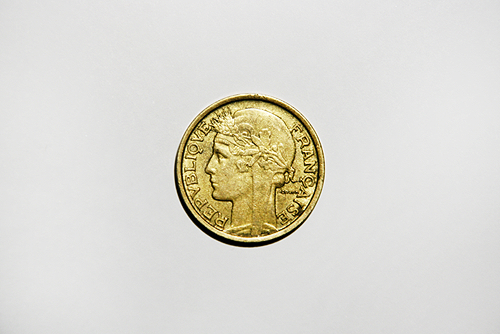
A week or so ago, I returned to the flea market where I'd discovered my Vietnam-era lapel pins and Lautrec-themed tea mugs. As promised, I'd come back for the 1940 New Zealand Penny with George VI.

Fortunately, after rummaging through the box of coins for what I had intended to find, I had also come across a few other coins. The owners were offering some sort of "two coins for one dollar" deal (not at all smart on their behalf, but very lucky on mine), so I grabbed a few extra. I had trouble finding a fourth coin that I wanted, but, ironically, it turned out to be the most valuable one, a Victorian farthing (a quarter penny, or around £0.50 today) from 1881. The others include aforementioned 1940 New Zealand Penny, a 1919 British Penny, and a 1938 French Two Francs. They're not worth a fortune, slightly less than $30 if anything, but it was quite a bargain regardless. Here they are in reverse-chronological order.