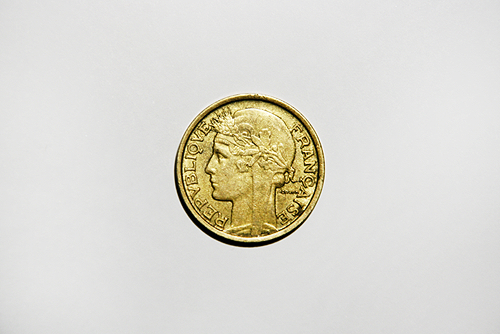
A week or so ago, I returned to the flea market where I'd discovered my Vietnam-era lapel pins and Lautrec-themed tea mugs. As promised, I'd come back for the 1940 New Zealand Penny with George VI.
Fortunately, after rummaging through the box of coins for what I had intended to find, I had also come across a few other coins. The owners were offering some sort of "two coins for one dollar" deal (not at all smart on their behalf, but very lucky on mine), so I grabbed a few extra. I had trouble finding a fourth coin that I wanted, but, ironically, it turned out to be the most valuable one, a Victorian farthing (a quarter penny, or around £0.50 today) from 1881. The others include aforementioned 1940 New Zealand Penny, a 1919 British Penny, and a 1938 French Two Francs. They're not worth a fortune, slightly less than $30 if anything, but it was quite a bargain regardless. Here they are in reverse-chronological order.
25 September 2011
14 September 2011
Tchaikovsky Feature
Tchaikovsky is, without question (albeit a bit of competition from Liszt, Grieg, and Debussy), the pinnacle of classical music to me. I adore the entire Romantic Era (what is modernity how does it work), but Tchaikovsky is exceptional, so here are some of my preferred pieces.
Pyotr Ilyich Tchaikovsky was born on the 7th of May, 1940, in Votkinsk, in the Russian Empire. Composing music from the age of 14, Tchaikovsky went on to study at the St. Petersburg Conservatory and, at the age of 26, began to teach at the Moscow Conservatory. Come the early 1870's, Tchaikovsky was becoming internationally noted for his moving, dramatic melodies. With aid by a hefty commission by Nadezhda von Meck, Tchaikovsky continued to compose such works as Eugene Onegin, The Nutcracker, and Swan Lake, among a myriad of other pieces.
Nocturne in C-sharp minor, Op. 19, No. 4 (1873)
Piano Concerto No. 1 in B-flat minor, Op. 23, 1st Mvt. (1875)
Polonaise from Eugene Onegin, Op. 24 (1878)
Serenade for Strings in C major, Op. 48 - I. Pezzo in forma di sonatina: Andante non troppo - Allegro moderato (1880)
1812 Overture, Op. 49 (1880)
Symphony No. 5 in E minor, Op. 64 - II. Andante cantabile, con alcuna licenza (1888)
The Nutcracker, Op. 71 - Act II, Pas De Deux: Variation II: Dance Of The Sugar-Plum Fairy (1892)
Polonaise from Eugene Onegin, Op. 24 (1878)
Serenade for Strings in C major, Op. 48 - I. Pezzo in forma di sonatina: Andante non troppo - Allegro moderato (1880)
1812 Overture, Op. 49 (1880)
Symphony No. 5 in E minor, Op. 64 - II. Andante cantabile, con alcuna licenza (1888)
The Nutcracker, Op. 71 - Act II, Pas De Deux: Variation II: Dance Of The Sugar-Plum Fairy (1892)
Labels:
music,
tchaikovsky
11 September 2011
Downton Abbey and why you should find time to watch it
Downton Abbey comes back for a second season this time next week, and I could not be more thrilled, ergo I feel the need to pimp it out. Another side of the blogosphere recommended it to me recently, and I've fallen in love and I can't get up. It's a well executed period drama, and well worth watching.
Downton Abbey centers around the life of an aristocratic family, the Crawley's, in early 20th century England. It follows both the conundrums of the family itself, and its numerous servants and staff. This ranges anywhere from the Crawley's eldest daughter's attempts to find a husband, to a housemaid looking for a job as a secretary.
It shares many characteristics with a Jane Austen novel, only holds the advantage of being set in a more current time period. This allows for the seamless interweaving of cultural and historical plot lines, such as the Titanic, women's rights, and the Great War, which also helps the series to be centered on more than just marital problems. It doesn't involve quite as much social commentary as an Austen work would, however, it does copy the (sometimes excessive) melodrama quite well.
The plot line does not bore or drone on, as the series moves incredibly quickly. Two years are covered in the first series, and a gap of another two is inserted before the second (for all we know series five will be set in 1973). The soundtrack, composed by Little Dorrit's John Lunn, is a perfect fit. Costume design for this series is stellar, especially for someone who adores 1910's fashion (the sheer abundance of hats is enough to make me squirm). The acting is nothing short of stunning, and the faces are just, well, let's put it this way:
The painfully romantic storylines between Dan Stevens and Michelle Dockery's characters (out-of-place distant relative Matthew Crawley and eldest daughter Mary Crawley, respectively), and Joanne Froggatt and Brendan Coyle's characters (Head Housemaid Anna and Valet Mr. Bates), are a highlight, in my opinion, and somewhat reminiscent of a Jane Austen-esque story. Dame Maggie Smith's portrayal of the Countess of Grantham is another favorite; her blatantly aristocratic attitude (à la "what is a weekend?") is an endless treasure trove of hilarious sardonic remarks.
Of course, stripped of the period appeal, Dowton would most likely be treading near soap opera ground, but the hats really do save it. Overall, the series does a commendable job of taking the seemingly mundane life and culture of the beginning of the 20th century and transforming it into a cacophony of music, costume design, acting, and often heartbreaking storylines that are sure to please. Find a box of tissues if you are emotionally volatile; Julian Fellowes, the writer, is practically a sadist when it comes to creating an endless array of obstacles to prevent good things from happening. Watching this show is essentially a masochistic experience.
Season two premieres on ITV on September 18th, and on PBS in the United States on January 8th of next year, so I would suggest finding your way to the former. Happy watching.
Labels:
culture,
downton abbey,
television
07 September 2011
Art: Edward Hopper
Edward Hopper was born in Nyack, New York on July 22nd of 1882. Trained as an illustrater, Hopper later became a member of the Ashcan School (of famed John Sloan, Arthur B. Davies, and Maurice Prendergast), and continued to cultivate his own particular style.
Starting in the mid 20's, Hopper's style became more concrete, his paintings stern and geometric, and his subjects isolated and anonymous. A master of light and space, Hopper is celebrated as one of America's most exceptional artists.
Here are a few Hopper favorites of the public's and my own.
Starting in the mid 20's, Hopper's style became more concrete, his paintings stern and geometric, and his subjects isolated and anonymous. A master of light and space, Hopper is celebrated as one of America's most exceptional artists.
Here are a few Hopper favorites of the public's and my own.
![]() |
| Arguably Hopper's most famous work, Nighthawks, 1942. |
![]() |
| Chop Suey, 1929. |
![]() |
| Gas, 1940. |
![]() |
| House by the Railroad, 1925. |
![]() |
| Summertime, 1943. |
![]() |
| Summer Evening, 1947. |
![]() |
| New York Office, 1962. |
![]() |
| Morning Sun, 1952. |
![]() |
| The Lighthouse at Two Lights, 1929. |
![]() |
| Automat, 1927. |
Labels:
art,
culture,
edward hopper
28 August 2011
Threadbare Flea Markets Dot Com
Honestly, I expected there to be far more junk the elderly have left behind sitting around in flea markets. Of course, I only stopped by one, but aside from expired cosmetics, kitschy porcelain kittens, sunglasses of questionable quality, and garden vegetables, I could barely find anything. I did, nevertheless, snatch up a few lackluster items.
The first is a set of two military pins. From what the internet has helped me ascertain, they're grade E-4 and US Marine Corps. Dating them, however, has proven to be difficult. The clutches read "Ballou Reg'd" and "Jandy Reg," which leads me to believe they're from the 1960's, most likely Vietnam.
Otherwise, I also managed to grab a set of English bone china Henri de Toulouse-Lautrec themed tea mugs from Royal Windsor. They're not expensive china, actually relatively cheap, but the set of four was inexpensive and Lautrec is one of my favorite artists, so I couldn't restrain myself.
They include Aristide Bruant, Jane Avril, La Goulue, and Divan Japonais.
Among other noteworthy things I did not purchase there was an overpriced WWII Good Conduct Medal and a 1940 New Zealand penny with King George VI on the obverse (the latter which I will probably come back for next time, to be honest).
Moral of the story- don't expect much from flea markets, and do your research before opening your wallet.
24 August 2011
Costume Institute Part One: Yves Saint Laurent
Public archives are the greatest thing to ever be great, especially when it comes to major museums like the The Metropolitan Museum of Art. In addition to its extensive archives of artwork, the Met also has a database called The Costume Institute, its historical fashion branch. Anything from a Mantuan dress from the late 17th century, to jackets by John Galliano, The Costume Institute archives it all by the thousands. Since digging around public archives is a pastime of mine, I figured I would share my favorites from this one, featured by designer, starting with Yves Saint Laurent.
Born in French Algeria in 1936, Yves Saint Laurent was a prominent French designer who, after working extensively for Dior, started his own company. Known for its incredibly constructed, yet feminine silhouettes and its introduction of prêt-à-porter (ready-to-wear), YSL remains one of the leading French brands to date.
![]() |
| Evening Ensemble Silk Fall/Winter '83-84 |
![]() |
| Shoes Feathers, Leather, Synthetic 2004 |
![]() |
| Pantsuit Wool Spring/Summer '70 |
![]() |
| (House of Dior) Cocktail Dress Silk Spring/Summer '59 |
![]() |
| "L'Eléphant Blanc" (House of Dior) Evening Dress Silk, Metallic thread, Glass, Plastic Spring/Summer '58 |
![]() |
| "Refrain" (House of Dior) Cocktail Dress Silk Spring/Summer '58 |
![]() |
| Dress Wool Fall/Winter '65-66 |
![]() |
| Evening Ensemble Silk, Metallic thread, Beads, Sequins Spring/Summer '80 |
21 August 2011
Old Suitcases and Co.
Among the myriad of my grandfather's old attaché's and books that my father showed me this summer (all of which I wanted to keep, in all honesty), I found a suitcase. Cleaning up some years ago, my father had stuffed it full of old books and left it behind a sofa. I spent an hour or so rummaging through it, flipping through books filled with plays and other literary works.
More than the books, however, I wanted the suitcase. With a quick paint job and some W2, it would be good as new.
![]() |
| Anything from "The Music of Foreign Nations" to "The Secret of the Siberia Platform" to "Dictionary of the Amateur Gardener". |
![]() |
| "HEY, PEOPLE! Collection of one-part plays against the imperialist war, and the bourgeois and fascist morality" 1967, not-so-subtle literary propagada. |
![]() |
| Apparently produced in the Leather Goods Factory of Vilnius in December of 1974. Price- four rubles and eighty kopeks. |
Subscribe to:
Posts (Atom)